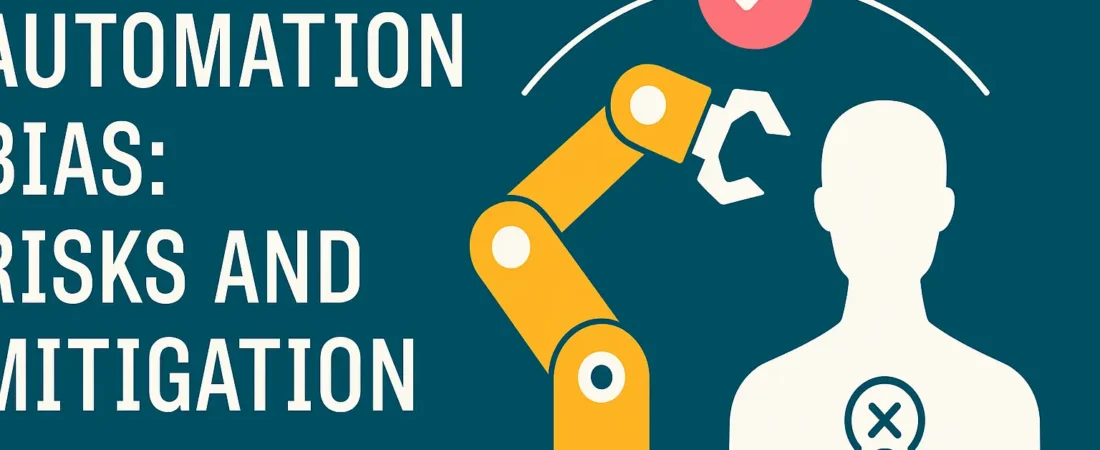
The modern workplace is in the throes of an AI revolution. From clinical decision support systems and algorithmic trading platforms to automated recruitment tools and AI-powered operational software, intelligent systems are becoming ubiquitous collaborators. The promise is immense: heightened efficiency, data-driven insights, and the reduction of human error. However, this rapid integration has unveiled a pervasive and insidious psychological pitfall—Automation Bias. This cognitive tendency to over-rely on automated cues, often at the expense of human judgment and critical thinking, is emerging as a critical risk factor across industries. When left unaddressed, it doesn’t just lead to minor inefficiencies; it precipitates catastrophic failures, entrenches systemic discrimination, and undermines the very expertise it was designed to augment. Understanding the psychological underpinnings, real-world consequences, and evidence-based mitigation strategies for automation bias is no longer a niche concern but an organizational imperative for the age of AI.
Defining the Phenomenon: The Core Mechanisms of Automation Bias
Automation bias is not merely passive trust in technology. It is an active cognitive shortcut where humans favor suggestions from automated systems and disregard contradictory information from non-automated sources, leading to a marked decline in independent critical thinking. This phenomenon represents a fundamental substitution of one’s own vigilance and investigative processes with algorithmic outputs, which are often incorrectly perceived as inherently neutral and objective.
The primary manifestations of automation bias are two distinct categories of errors, reflecting both active over-reliance and passive neglect:
- Errors of Commission: These occur when a user actively follows an incorrect automated suggestion, despite having access to conflicting evidence or personal expertise. This is a direct result of misplaced trust, where the user effectively cedes their agency to the machine. For instance, in clinical settings, physicians have been documented failing to correct inaccurate computer-generated interpretations of electrocardiograms (ECGs), leading to inappropriate treatments. One study found that physicians failed to correct erroneous diagnoses in 92 cases, resulting in inappropriate treatments for 10% of patients and unnecessary diagnostic exams for 24%. Similarly, in simulated personnel preselection, participants were more likely to select less-qualified applicants simply because an AI system recommended them.
- Errors of Omission: These occur when a user fails to detect or respond to a system failure because the automation did not generate an alert or flag a problem. This form of error reflects a passive state of complacency and reduced monitoring, where the user assumes the system is functioning correctly without sufficient verification. This is prevalent in continuous monitoring tasks. For example, pilots in highly automated aircraft have been observed to reduce their visual scanning of primary flight instruments, leading to failures to notice dangerous deviations from the correct flight path. In baggage X-ray screening, omission errors spiked significantly when an automated weapon detection system failed to identify a threat.
These two error types demonstrate that automation bias degrades human performance by undermining both the active application of judgment and the passive monitoring required for safety. The phenomenon is closely related to, and often fueled by, automation complacency—a state of reduced vigilance arising from assumed system reliability. Conversely, algorithmic aversion, or the skepticism some users show towards AI, highlights the dual challenge organizations face: the pendulum can swing between over-trust and under-trust. The ideal state is one of calibrated trust, where reliance on AI is appropriately balanced with critical human oversight.
The Psychological Engine: Why We Over-Rely on AI
The inclination to over-rely on automation is not arbitrary; it is driven by a sophisticated interplay of cognitive biases, individual user traits, and environmental pressures.
At its core, automation bias is often explained by the cognitive miser hypothesis. Humans naturally seek to conserve mental effort. When faced with a complex task, users subconsciously weigh the cognitive cost of independently verifying an AI’s output against the perceived benefit. If the AI’s suggestion seems plausible, the low cost of uncritical acceptance makes overreliance a rational, utility-maximizing choice, especially under time pressure or high workload.
This efficiency-seeking behavior is powerfully amplified by a host of specific cognitive biases:
- Confirmation Bias: Users are more likely to accept AI recommendations that align with their own initial assessment while being more skeptical of contradictory advice.
- Anchoring Bias: The first piece of information received, often the AI’s recommendation, creates a mental anchor that disproportionately influences all subsequent decisions, making it difficult to dislodge.
- Overconfidence Bias: This can paradoxically lead to over-reliance, as individuals who believe in their own judgment may also be more likely to defer to an AI they perceive as an expert “partner,” solidifying their tentative conclusions without sufficient scrutiny.
Individual differences also play a profound role. AI literacy exhibits a surprising non-linear relationship with overreliance, mirroring the Dunning-Kruger effect. Individuals with minimal knowledge tend toward algorithmic aversion. Those with moderate knowledge show the highest levels of automation bias, as their superficial understanding fosters unwarranted confidence. Only users with deep, high-level AI knowledge demonstrate appropriately calibrated trust. Professional experience generally reduces susceptibility, but it is not a foolproof defense. Studies show that even highly experienced radiologists and cardiologists suffer significant accuracy declines when presented with flawed AI suggestions. In fact, one randomized trial found that physicians with above-median clinical experience suffered a greater decline in diagnostic accuracy when exposed to erroneous AI recommendations, possibly due to a greater reliance on heuristics.
Finally, the task environment and system design exert powerful influence. High verification complexity—the cognitive effort required to check an AI’s output—is strongly associated with automation bias. When verification is demanding, users are more likely to accept recommendations uncritically. Time pressure heightens dependence on flawed AI by reducing the capacity for independent verification. The design of the interface itself is critical; interfaces that present AI advice prominently and in a commanding tone can induce over-acceptance, while those that support an internal locus of control and provide salient cues for errors can dramatically reduce overreliance.
High-Stakes Failures: The Tangible Cost of Automation Bias
The theoretical risks of automation bias are starkly illustrated by a series of real-world incidents across critical domains, proving the consequences are both concrete and severe.
- Aviation: This is one of the most studied domains for automation bias. The crashes of Eastern Airlines Flight 401 (1972) and Air France Flight 447 (2009) were both partly attributed to crews failing to monitor instruments and overriding critical information when automated systems failed. More recently, in 2015, Air Canada Flight 624 crashed after its crew, relying on the autopilot, failed to notice the aircraft had deviated dangerously low on its approach.
- Medicine: A landmark 2023 study on mammography showed that incorrect AI suggestions caused radiologist accuracy to plummet, from nearly 80% to just 20% for inexperienced readers, and from 82.3% to 45.5% for the most experienced. A systematic review of ECG interpretation found clinicians changed their correct diagnosis to follow an inaccurate computer recommendation in 6% to 11% of cases. E-prescribing systems have been shown to increase commission errors by 56.9% when alerted by incorrect clinical decision support.
- Finance and Justice: The financial sector has seen dramatic losses, such as Knight Capital’s $440 million loss in 45 minutes due to a flawed trading algorithm. The British Post Office Horizon scandal saw over 700 subpostmasters wrongfully prosecuted due to an unreliable automated accounting system, a catastrophic failure of organizational oversight and a stark example of automation bias in a legal context.
- National Security: Survey experiments have found that individuals with moderate AI knowledge exhibit the highest levels of automation bias in tasks like military aircraft identification. Real-world incidents, such as Patriot missile system failures in 2003, have been linked to operators’ reluctance to override automated friend-or-foe tracking systems.
These cases collectively demonstrate that automation bias is a potent force capable of causing massive, tangible harm, from loss of life and wrongful imprisonment to financial ruin and systemic operational failure.
The Vicious Cycle: How Automation Bias Amplifies Prejudice
A deeply concerning aspect of automation bias is its role in creating a self-perpetuating feedback loop that reinforces and amplifies societal prejudices. This cycle begins with algorithmic bias, where AI systems trained on biased historical data learn and replicate those same inequalities. Documented examples include Amazon’s recruiting tool penalizing resumes with the word “women’s,” and a healthcare algorithm that systematically underestimated the needs of Black patients by using health costs as a proxy for need.
Once deployed, these biased systems create the conditions for feedback loop bias. When professionals uncritically accept flawed AI recommendations, their decisions are fed back into the system’s training data for future model iterations. The model then learns from its own mistakes, reinforcing and propagating the original biases over time. This creates a vicious cycle where the AI’s performance in underrepresented groups degrades, and humans become progressively less critical of its increasingly biased outputs.
Perhaps most alarmingly, recent research shows that human-AI interaction can actively induce and increase human bias over time. Experiments have demonstrated that interacting with a slightly biased AI causes participants to become progressively more biased themselves in perceptual and social judgment tasks. This effect was significantly stronger with AI than with other humans, driven by the perception of AI as superior and more objective. This reveals a troubling spiral: biased AI -> biased human -> more biased AI, underscoring that the solution cannot be limited to fixing algorithms but must also address the human cognitive vulnerabilities that AI exploits.
Re-evaluating Common (But Ineffective) Solutions
Despite growing awareness, many commonly proposed solutions have proven surprisingly ineffective or even counterproductive.
- General AI Literacy Training: The assumption that providing users with information about AI will foster critical engagement is overly optimistic. A randomized controlled trial with 44 physicians found that a comprehensive 20-hour AI literacy program was insufficient to prevent a significant drop in diagnostic accuracy when exposed to flawed AI recommendations. The training may create a false sense of security without imparting the practical skills needed for critical evaluation.
- Structured Debiasing Tools: Tools like the ‘SLOW’ checklist (Stop and think, Look for contradicting findings, etc.) have shown positive qualitative feedback but fail to yield statistically significant improvements in quantitative performance. Translating theoretical debiasing techniques into measurable, high-stakes improvements remains a significant challenge.
- Explainable AI (XAI): The strategy of providing post-hoc explanations for AI outputs to build transparency and trust has largely failed to mitigate automation bias. Multiple studies found that explanations often reinforce misplaced trust, as users interpret detailed rationales as endorsements of the AI’s trustworthiness—a “fool’s gold” effect. Visual explanations like heatmaps can act as visual heuristics, narrowing the user’s focus. In some “human-first” protocols, XAI has been shown to have a detrimental effect on accuracy, a phenomenon known as the “white-box paradox,” where explanations trigger confirmation bias and reduce willingness to re-evaluate initial judgments.
This body of evidence forces a re-evaluation of prevailing wisdom. Simply providing more information or superficial transparency is not a panacea. The challenge lies in designing interventions that fundamentally alter the cognitive process of decision-making.
A Multi-Layered Defense: Evidence-Based Mitigation Strategies
Given the limitations of traditional approaches, a more sophisticated, multi-layered defense is required, combining intelligent system design, optimized organizational policies, and targeted human interventions.
- Cognitive Forcing Functions (CFFs): These are interventions designed to disrupt intuitive, System 1 thinking and compel analytical, System 2 reasoning. Unlike simple explanations, CFFs actively require a deliberative step before an AI suggestion is presented—for example, by requiring the user to formulate their own answer first or introducing a mandatory delay. Experimental studies consistently show CFFs are more effective at reducing overreliance than XAI. The trade-off is that users find them more mentally demanding and often prefer simpler, less intrusive systems, even if those systems lead to poorer performance. Their effectiveness is also moderated by individual traits like “Need for Cognition,” meaning they could inadvertently widen performance gaps.
- Intelligent System and Interface Design: This is arguably the most critical lever. The adoption of Human-in-the-Loop (HITL) models must be sophisticated to avoid “rubber-stamping.” A more advanced strategy is “mitigated deployment,” which involves universal AI deployment coupled with built-in safety nets for subgroups where the model performs poorly. For example, the NHS used this for a skin cancer detection AI, requiring a dermatologist’s “second read” on all AI-flagged lesions, with extra focus on patients with darker skin tones. This protects vulnerable populations while gathering data for improvement.
- Graded Autonomy: Allowing users to easily adjust the level of automation and intervene seamlessly is crucial.
- Dynamic Confidence Scores: Displaying updated confidence levels for each recommendation, rather than a fixed system-wide score, helps users calibrate trust more accurately.
- Workflow Protocol: The order of interaction matters profoundly. “AI-first” protocols (showing the suggestion before the human assessment) consistently lead to higher team accuracy than “human-first” protocols, though they increase susceptibility to anchoring. Designers must make an explicit choice about this trade-off.
- Organizational Culture and Policy: Successful mitigation requires a supportive ecosystem.
- Culture of Healthy Skepticism: Organizations must actively foster an environment where questioning AI outputs is encouraged, not stigmatized.
- Targeted, Scenario-Based Training: Training should be tailored to different literacy levels and deliberately expose users to AI failure scenarios to build realistic expectations.
- Clear Accountability: Clear lines must be established, reinforcing that humans remain legally and professionally responsible for final decisions.
- Robust Regulatory Frameworks: Regulations like the EU AI Act and FDA guidance are beginning to mandate high-quality data, transparency, and human oversight for high-risk AI. They emphasize the need for continuous post-market surveillance to detect emerging biases like concept drift and feedback loop bias, ensuring AI systems remain safe and fair throughout their lifecycle.
Conclusion
Automation bias represents a critical challenge in the age of artificial intelligence. It is a deeply rooted cognitive tendency, exacerbated by opaque AI, biased training data, and often-unintuitive human-machine interfaces. The evidence is clear: simplistic solutions like generic training and post-hoc explainability are insufficient and can be counterproductive. To navigate this risk, organizations must adopt a multi-layered, evidence-based defense. This begins with intelligent system design that incorporates Cognitive Forcing Functions and implements safeguarded Human-in-the-Loop models like mitigated deployment. It extends to building strong organizational cultures that value critical inquiry, supported by evolving regulatory frameworks that mandate accountability and continuous monitoring. Ultimately, the goal is not to eliminate AI assistance but to recalibrate the human-technology partnership, ensuring that AI serves as a powerful collaborator that genuinely augments, rather than supplants, human judgment and expertise.
References
- https://pmc.ncbi.nlm.nih.gov/articles/PMC9795935/
- https://cicl.stanford.edu/papers/vasconcelos2023explanations.pdf
- https://www.sciencedirect.com/science/article/pii/S2667096823000125
- https://pmc.ncbi.nlm.nih.gov/articles/PMC11897215/
- https://www.researchgate.net/publication/392771285_Exploring_automation_bias_in_human-AI_collaboration_a_review_and_implications_for_explainable_AI
- https://academic.oup.com/isa/article/68/2/sqae020/7638566
- https://www.forbes.com/sites/bryechoffman/2024/03/10/automation-bias-what-it-is-and-how-to-overcome-it/
- https://pmc.ncbi.nlm.nih.gov/articles/PMC3240751/
- https://www.sciencedirect.com/science/article/pii/S2666449624000410
- https://www.frontiersin.org/journals/psychology/articles/10.3389/fpsyg.2023.1118723/full
- https://www.nature.com/articles/s41591-021-01595-0
- https://arxiv.org/html/2411.00998v1
- https://academic.oup.com/jamia/article/24/2/423/2631492
- https://bmcmedethics.biomedcentral.com/articles/10.1186/s12910-025-01243-z
- https://www.sciencedirect.com/science/article/pii/S0003687024002333
- https://www.tsb.gc.ca/eng/rapports-reports/aviation/2015/a15h0002/a15h0002.html
- https://cset.georgetown.edu/publication/ai-safety-and-automation-bias/
- https://link.springer.com/article/10.1007/s00146-025-02422-7
- https://www.medrxiv.org/content/10.1101/2025.08.23.25334280v1.full.pdf
- https://www.sciencedirect.com/science/article/abs/pii/S000437022300098X
- https://pubmed.ncbi.nlm.nih.gov/39234734/
- https://oaj.fupress.net/index.php/formare/article/download/17122/13856/80903
- https://pubmed.ncbi.nlm.nih.gov/27516495/
- https://www.nature.com/articles/s41562-024-02077-2
- https://lis.seas.harvard.edu/papers/2021/bucinca21trust.pdf
- https://dl.acm.org/doi/10.1145/3449287
- https://bmcmededuc.biomedcentral.com/articles/10.1186/s12909-018-1444-3
- https://www.stat.cmu.edu/~rfogliat/files/msr_study.pdf
- https://pmc.ncbi.nlm.nih.gov/articles/PMC12258279/
- https://www.bmj.com/content/377/bmj-2022-070904